


Controlling Deforming Ground: Why Friction Stabilizers Outperform in Squeezing Rock
Every underground engineer eventually runs into ground that refuses to stay still. Whether you call it "squeezing ground," "swelling clay," or just a heavy, converging roof, dealing with a tunnel that wants to close in on you is a massive headache.
If you try to fight this kind of dynamic rock with purely rigid support-like a stiff, fully-grouted rebar bolt-you'll usually end up with snapped steel and a failed roadway. The rock has too much mass; it will break anything that refuses to move with it.
That's where Friction Stabilizers, universally known as Split Sets, prove their worth. They don't fight the rock's movement; they manage it. Let's look at the geometry and physics of why they work so well in deforming ground.
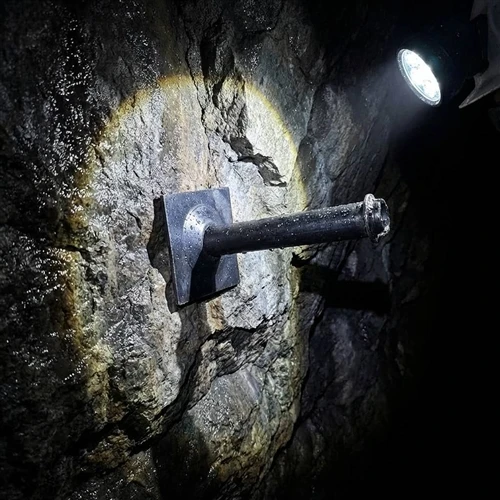
At first glance, a split set looks simple: a C-shaped steel tube with a tapered end and a welded-on ring for the anchor plate. But the engineering is all in the mathematics of the cross-section.
The outer diameter of the tube is intentionally manufactured to be slightly larger than the drill hole. When you drive it into the hole (using a pneumatic hammer or a jumbo rig), the C-shape is forced to compress slightly.
This creates massive, continuous radial friction along the entire length of the borehole wall.
Unlike a point-anchored mechanical bolt, a friction stabilizer grips the rock from top to bottom, distributing the load evenly.
2. The Power of "Yielding" (Working With the Rock)

Here is the main reason friction stabilizers excel in squeezing ground: they can yield.
When the surrounding strata begin to converge, a rigid resin bolt experiences extreme shear stress until it snaps. A split set, however, has a built-in release valve. If the ground movement exceeds the friction threshold, the inner tube can slip slightly within the borehole without losing its holding capacity.
It absorbs the kinetic energy of the moving rock.
It deforms gracefully while maintaining active clamping pressure on the surface plate and the rock face.
It's essentially a shock absorber for your tunnel.
Aside from geomechanics, site managers love split sets for one simple reason: speed.
In fast-paced development headings, every minute counts. Resin bolts require drilling, hole cleaning, capsule insertion, spinning, and waiting for cure time. Split sets? You drill the hole, drive the bolt home, and you're done. There's no chemical waiting period. For temporary support or immediate face stabilization right after a blast, nothing beats the installation speed of a friction stabilizer.

4. The Practical Reality: Where Not to Use Them

Being honest about product limitations is what good engineering is all about. Split sets have thinner steel walls compared to heavy-duty rebar bolts.
If you're dealing with highly acidic or wet groundwater, untreated steel split sets will corrode quickly. That's why in corrosive environments, you must use Hot-Dip Galvanized (HDG) split sets.
They also shouldn't be your first choice for massive, dead-weight static loads in hard, blocky rock where a stiff resin bond is strictly required. Match the tool to the geology.


FAQ
Q: What international standards do your self-drilling anchor bolts comply with?
A: Our SDA systems (including R-thread and T-thread) are manufactured in strict accordance with ISO 10208 and ASTM standards. We use high-strength seamless steel tubing to ensure superior tensile and yield strength for demanding mining and tunneling projects.
Q: Why are SDA bolts more efficient than traditional rock bolts in fractured ground?
A: Traditional bolts require a pre-drilled hole which often collapses in loose ground. The SDA system combines drilling, grouting, and anchoring into a single operation. This eliminates the need for casing pipes and prevents borehole collapse, saving up to 50% of installation time.
Q: How do your spherical nuts handle uneven rock surfaces?
A: Our precision-engineered spherical nuts (dome nuts), when paired with domed plates, allow for 7 to 10 degrees of angular compensation. This ensures that the bolt maintains a secure, perpendicular load distribution even when the tunnel face is irregular or uneven.
Dealing with deforming ground is a game of physics, not brute force. By allowing controlled slip while maintaining continuous radial friction, split sets give you a flexible, reliable line of defense against converging strata.
At Zhongfu Mining, we roll our friction stabilizers from high-grade steel with strictly controlled slot tolerances. That means consistent insertion force and reliable pull-out friction every single time you drive one into the roof.
Got a tricky ground condition on your site?
[Reach out to our engineering team]. Let's talk about hole diameters, steel thicknesses, and the right friction stabilizer specs for your underground layout.
Our address
West Side Of Jianshe Street, Southwest Industrial Zone, Linmingguan Town, Handan, Hebei, China
Phone Number
easonoflangben@langben.net

Get a Free Project Material Cost Calculation