


Everything You Need to Know About Resin Capsules: Definition, Use & Safety
Section 1: What is a Resin Anchoring Agent (Resin Capsule)?
A Resin Anchoring Agent, commonly known in the international market as a Resin Capsule or Resin Cartridge, is a high-performance, two-component chemical anchoring system. It is designed to provide immediate and permanent reinforcement for rock bolts in underground mining, tunneling, and civil engineering projects.
At its core, it is a dual-compartment plastic film pouch filled with a sophisticated chemical grout that transforms from a soft mastic into a rock-solid adhesive within seconds or minutes of activation.
Section 2 : Key Components of resin capsule
As a leading manufacturer, we ensure our resin capsules are formulated with precision-grade chemicals to guarantee stability and strength:
The Mastic (Main Body)
Composed of high-quality Unsaturated Polyester Resin (UPR) mixed with specific mineral fillers. This component determines the ultimate compressive and shear strength of the anchor.
The Catalyst (Hardener):
A separate compartment containing a reactive agent (typically Benzoyl Peroxide or BPO).
The Barrier
A high-strength, chemical-resistant polyester film that keeps the resin and catalyst separated until the moment of installation.
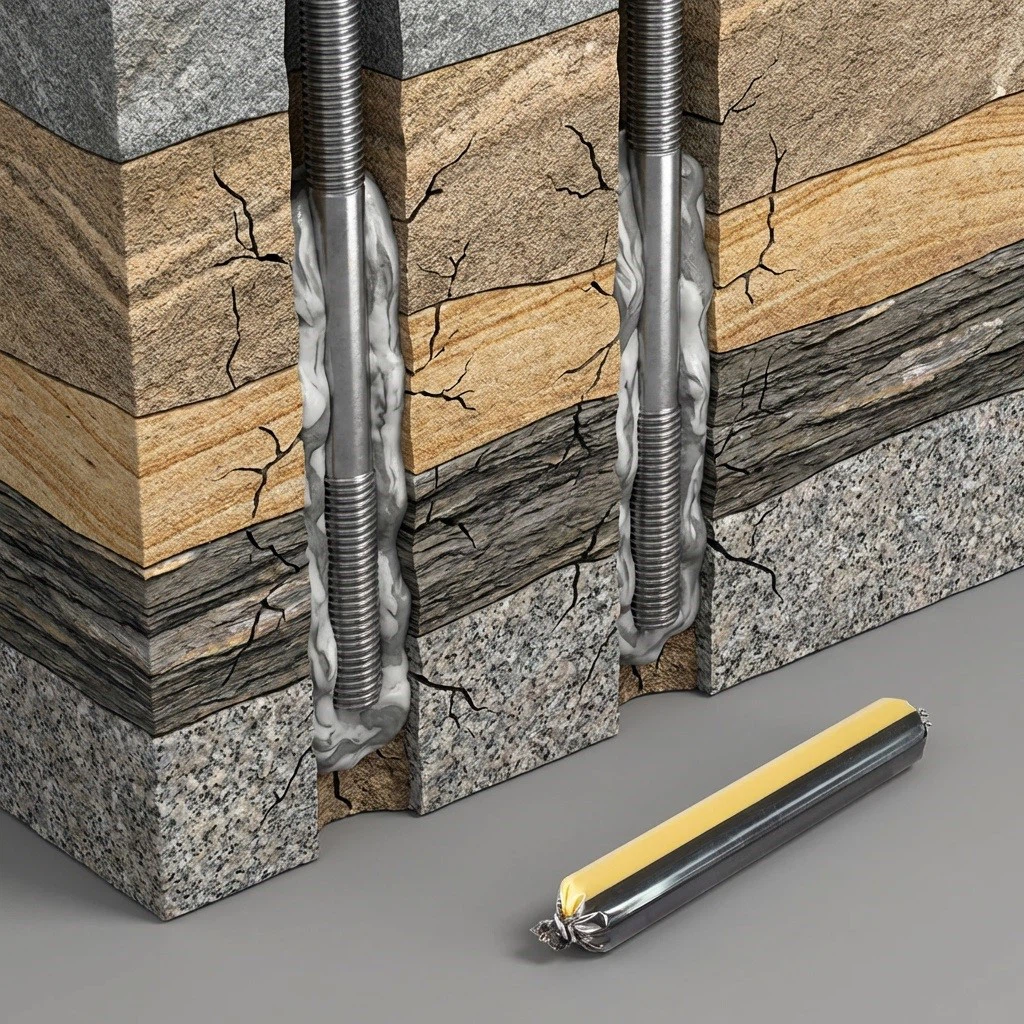
To understand what a resin capsule is, we must look at its chemical precision. Not all resin capsules are created equal. As a manufacturer, we focus on three critical chemical aspects:
The Resin Matrix:
We use premium Unsaturated Polyester Resin (UPR). The viscosity of this resin is crucial; it must be thick enough to hold the filler in suspension but reactive enough to bond with the rock bolt surface instantly.
The Filler (The Strength Provider)
We mix the resin with high-purity limestone (calcium carbonate). The ratio of filler to resin determines the compressive strength. Our precision mixing ensures the capsule doesn't become too brittle or too soft.
The Film Quality
The outer skin is a specially formulated polyester film. It must be strong enough to resist accidental tearing during transport, yet fragile enough to shred completely and mix evenly when the bolt rotates. Residual un-shredded film is a common cause of anchoring failure-our film is designed for "Total Shred" performance.
As a direct manufacturer, we optimize the film thickness in Step 2 and the chemical reactivity in Step 3 to ensure your ground support is never compromised by local climate or equipment limitations.


01
Step 1: Insertion & Placement (The Preparation)
The process begins by inserting the resin capsule into a pre-drilled borehole. At this stage, the capsule acts as a protected chemical reservoir. Our high-strength polyester film ensures that the resin and catalyst remain completely separated and unreacted during transportation and insertion, even in rough borehole conditions.
Key Focus: Protective barrier & precise sizing.
02
Step 2: Mechanical Shredding & Mixing (The Activation)
As the rock bolt is inserted and rotated at high speed (typically 400-600 RPM), the bolt's ribs shred the capsule's skin. This mechanical action forces the resin mastic and catalyst to mix thoroughly. A "Total Shred" performance is critical here-our capsules are designed to leave no large film fragments, ensuring a 100% homogeneous mixture for maximum bond strength.
Key Focus: Homogeneous mixing & film fragmentation.
03
Step 3: Chemical Polymerization (The Curing)
Once mixed, a rapid exothermic chemical reaction occurs. The resin transforms from a liquid mastic into a hard polymer. This "Gel Time" is factory-tuned to match your site's ambient temperature. As the resin cures, it expands slightly, filling the micro-fissures in the borehole wall and tightly gripping the ribs of the steel bolt.
Key Focus: Controlled gel time & exothermic bonding.
04
Step 4: Interlocking & Load Transfer (The Reinforcement)
In the final stage, the hardened resin creates a powerful mechanical interlock between the bolt and the rock mass. This creates a "Full-Column Bond" that effectively transfers the geological load from the unstable strata to the steel bolt. The result is an immediate, high-tension reinforcement capable of withstanding heavy tectonic pressure and blasting vibrations.
Key Focus: Load transfer & structural stability.
Section 5: : Why Resin Capsules are Essential for Modern Mining & Tunneling?
In the challenging environments of deep-well mining and complex tunneling, the choice of ground support can mean the difference between operational success and catastrophic failure. Here is why high-performance resin capsules have become the global gold standard:
1. Immediate Load-Bearing Capacity (Speed & Efficiency)
Unlike traditional cement-based grouting which requires hours or days to cure, resin capsules offer near-instantaneous reinforcement.
Rapid Development: High-speed resin allows for "active tensioning" within minutes of installation. This significantly reduces the downtime in the mining cycle, allowing for faster advancement of the tunnel face.
Manufacturer Advantage: We calibrate our formulas to ensure that "Fast" means "Consistent," giving engineers the confidence to move machinery forward sooner.
2. Full-Column Bonded Reinforcement (Structural Integrity)
Resin capsules provide a Full-Column Bond, which is superior to point-anchor mechanical systems.
Uniform Support: By filling the entire annulus between the bolt and the borehole, the resin distributes the load along the entire length of the bolt. This prevents localized stress concentrations and effectively "knits" fractured rock layers into a single, stable beam.
Vibration Resistance: The polymer matrix absorbs energy from blasting vibrations and seismic events, maintaining the integrity of the support system better than rigid alternatives.
3. Superior Corrosion Resistance (Long-Term Safety)
Groundwater in mines and tunnels is often acidic or saline, which can rapidly degrade steel bolts.
Protective Encapsulation: The resin act as a high-density, waterproof barrier that completely encapsulates the steel bolt. This prevents oxygen and moisture from reaching the metal, significantly extending the lifespan of the support system in permanent tunnels and civil engineering projects.
Durability: Our resin's chemical stability ensures it does not shrink or degrade over decades of service.
4. Adaptability to Challenging Geology (Versatility)
Modern engineering often faces "bad ground"-soft strata, fractured rock, or high tectonic stress.
Fissure Grouting: The high injection pressure created during bolt rotation forces the liquid resin into small rock cracks, effectively "pre-grouting" and stabilizing the rock mass immediately around the hole.
Geological Flexibility: From coal mines to hard-rock gold mines, resin capsules can be customized in viscosity and gel time to perform in temperatures ranging from -10°C to +40°C.
Explore our full range of resin capsule Products


FAQ
Q: What is the shelf life of resin capsules, and how should they be stored?
A: Generally, resin capsules have a shelf life of 6 to 12 months from the date of manufacture, depending on the specific formulation. Because the resin is a chemically active material, it is sensitive to temperature.
Q: How do I choose the correct resin capsule diameter for my borehole and rock bolt?
A: For optimal anchoring, the "annulus" (the gap between the rock bolt and the borehole wall) should ideally be between 3mm and 6mm.
Q: How does ambient temperature affect the gel time of the resin?
A: How does ambient temperature affect the gel time of the resin?
Our address
West Side Of Jianshe Street, Southwest Industrial Zone, Linmingguan Town, Handan, Hebei, China
Phone Number
easonoflangben@langben.net
